Written & Directed by Ben Hirt
[ Logline ] In a world reshaped by AI, a Brooklyn superintendent’s humble, manual tasks remind us that meaning — not machines — is what makes us human.
[ Synopsis ] In an AI-driven future, Mario, a Brooklyn superintendent, carries out quiet, manual tasks that might seem mundane. Yet through his hands-on work, we see what truly makes us human: the creation of meaning through simple acts. In contrast to technological progress, Mario’s story asks us not what we can automate, but what gives our work, and ourselves, purpose.
[ Treatment ] We begin in vastness. The silent black of space. A distant star flickers. The Earth turns—clouds moving across blue. Time accelerates: continents shift, oceans churn, storms spiral.
A hard cut.
Rock strikes rock.
A spark.
Then another—rhythmic, urgent, like flint hitting stone. Sparks multiply, building momentum until a flame ignites. Fire fills the frame, illuminating ancient hands shaping stone tools.
The flame flickers forward through time. A bow is drawn. An arrow releases. The spark becomes electricity—crackling across wires. Nighttime cityscapes glow in grids of light. Countless windows illuminated. Countless screens awake.
We move inside the circuitry—into the digital pulse of the internet. Data streams. Connections multiply. A tunnel of infinite nodes.
We surge through.
And burst out over Brooklyn—Jane’s Carousel, the Bridge, the skyline. The camera flies past the rooftop and lands in Dumbo.
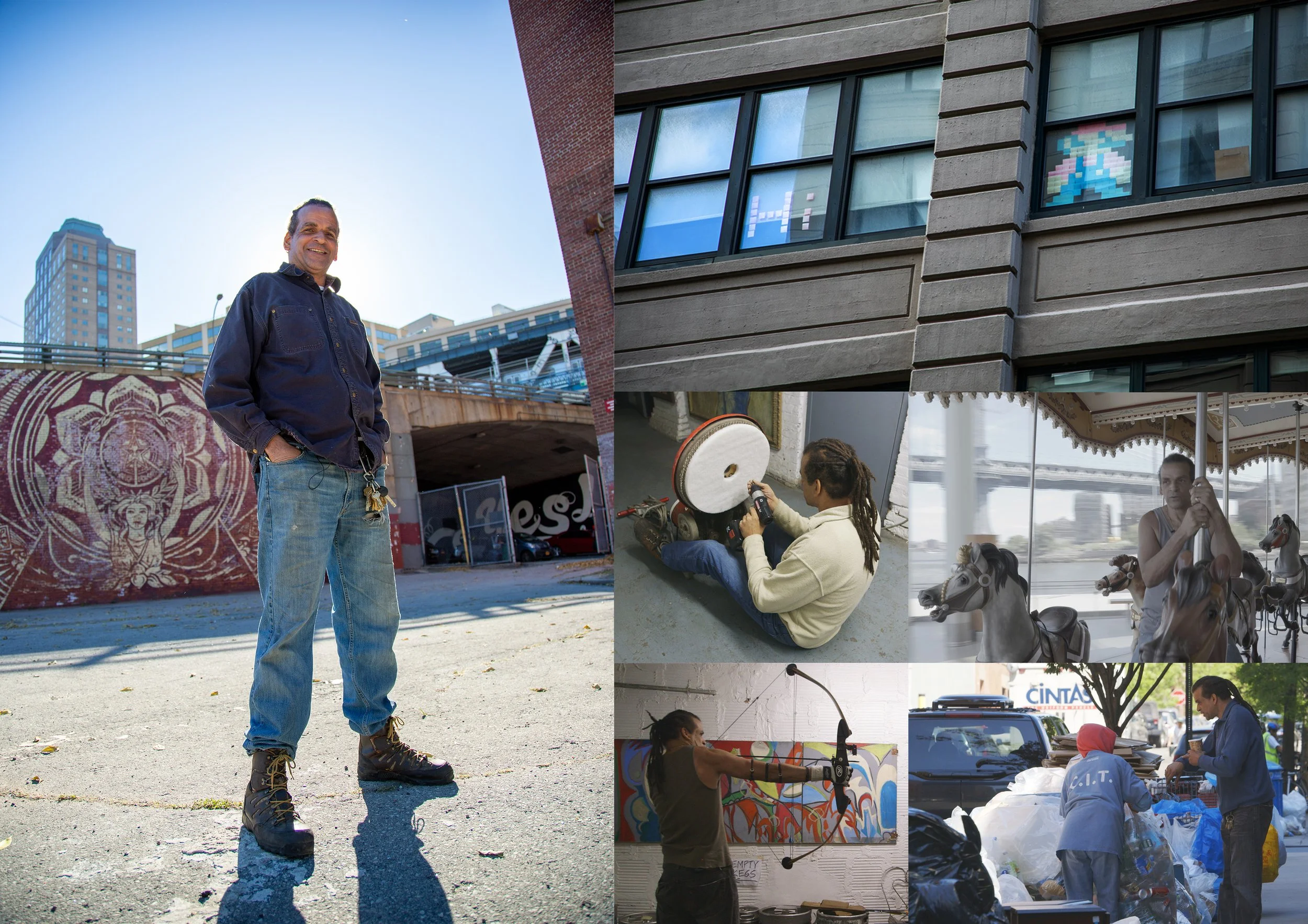
Emerging in D camera follows Mario down into his basement office—which is also his living space, complete with a bunk bed. Inside, old CCTV screens glow—his “windows” to the outside world. He proudly shows us his diplomas, explaining his path to becoming a superintendent. From there, we follow him repairing his polishing machine, riding the elevator, sharing thoughts on tenants. He pushes it through Dumbo streets, then leads us to a rooftop. There, with a sweeping view of the Brooklyn Bridge, the drone lifts us back out, transitioning us to the outside world once more.
From the rooftop, the camera lifts into a drone flight, revealing Jane’s Carousel, the East River, and the Manhattan skyline. The music transitions, and we cut straight into Dumbo streets. Here, we see a collage of diverse people—each absorbed in their smartphones as they walk. They pass one another without interaction, eyes locked on screens, whether alone or in groups. This silent sequence highlights a society present in body but distant in mind—juxtaposing the tactile, grounded reality we left with Mario, now replaced by digital absorption.
After the smartphone sequence, we cut to Mario from a distance, warmly interacting with Mimi, the can collector. Though we don’t hear their conversation, the friendly gestures and physical presence show a connection. Mario passes by, perhaps leaving something with her, but the focus is on the moment of shared humanity. This scene reminds us that even in small ways, Mario’s presence is part of the community’s fabric. We might then intercut some shots of him managing the neighborhood’s trash—small, meaningful tasks.
We transition into a breathtaking montage: robots handling intricate tasks, self-driving cars navigating effortlessly, doors unlocking with invisible systems, chatbots engaging like never before. We witness cutting-edge labs, dazzling breakthroughs—AI extending not just our hands, but our very minds. Yet, amidst this wonder, a question emerges: If machines can do all this, could they do what Mario does? And then, a pause—should they? The sequence leaves us contemplating what progress means, and at what cost.
In this next section, we return to Mario’s world, reflecting on what we risk losing. Mario shows us his smartphone collection—a personal museum of progress. In his basement, he impressively shoots a bow and arrow down the hallway. He explains the art of sweeping with a broom, preserving its bristles, and proudly recounts how he’s memorized every key on his chain, ready to open any door in an emergency. Finally, we follow him managing trash at night—where he jokingly calls a seat on a pile of garbage his “office.” Through these quirky moments, we ask: What parts of ourselves are we willing to replace, and at what cost to our humanity?
After Mario’s grounded quirks, we return to artificial (general) intelligence with a playful yet thought-provoking scene. A woman plays cards with a robot double of herself, identical in appearance. As they casually engage, we ask: when meaning becomes optional, and opting out has no cost, what are we really after? Is this the future we choose—playing cards with machines instead of each other? In this moment, humor softens the reflection—inviting us to consider what parts of ourselves we are willing to abandon, and why.
After we leave Mario’s nightly routine, we move into a new realm of artificial general intelligence. We see Nadine, a social robot designed to interact like a person, as she calls out bingo numbers to a group gathered around a table. The human participants react with delight, but we step back and reflect: if meaning has always been optional, now, with AGI, opting out has no cost at all. We ask, with gentle humor and a bit of wonder: are we now choosing to gather around robots instead of each other? This subtle, playful question leaves us considering what we’re really seeking—connection or automation.
We cut back to 2012, as Superstorm Sandy descends on New York, immobilizing the city. We show raw footage from Dumbo, water surging in, streets darkened, technology failing. In the midst of that chaos, we return to Mario, framed by his row of old monitors—his windows to the outside world. As he stares into the camera, he begins to share: during Sandy, his cash reserve saved neighbors when ATMs failed. In this quiet, resilient gesture, we realize how vital people like Mario are—those who stay connected to the real world, even when everything else falters. And so, we end with his keys and his cash—a reminder that, in a crisis, human presence still matters more than ever.
We leave the quiet resilience of Mario’s world and plunge into a vast, disorienting collage of artificial superintelligence. Images flash—cataclysmic data streams, towering neural networks, automated factories, and gleaming digital cities. The camera spins like a carousel, faster and faster, until all sense of orientation blurs. And in this dizzying whirl, we remember the quiet power of Mario, the real “Super” in Dumbo, as his name echoes in the background. What is it we chase in this rush toward superintelligence? Are we ascending to a brighter future—or spinning ourselves out of control, losing the human anchor we so desperately need?
We leave behind the dizzying whirl of artificial superintelligence and return to a quiet, reflective moment: Mario, on Jane’s carousel in Dumbo, spins slowly, gazing outward as the world turns. This quiet pause brings us back to the present, a sharp cut from abstraction to everyday life. We see Mario now, as he always is—cleaning windows, shoveling snow, tending to the small details of his buildings. In these mundane acts, we rediscover the essence of being human—the simple, steady tasks that ground us, that remind us of what still matters, even when the world spins out of control.
We cut to a stark, disquieting collage: the so-called godfathers of AI—CEOs, founders, and pioneers—stumble in silence, their confident façades slipping. They are unsure, as if realizing that the danger was never that machines would become human, but that humans might stop needing to be. A quiet tension hangs: does anyone know where we are going, or what we are after? Is any of this necessary? Their faces, caught in a web of uncertainty, blur into one another. As the collage dissolves, we are left with the question hanging in the air: is all of this progress, all this striving, really what we need?
Mario steps slowly toward the Dumbo waterfront, a couple of sticks in his hands. The towering skyline of New York City looms behind him, vast and indifferent. With calm focus, he kneels on the pavement and begins rubbing the sticks, sparks forming slowly, tentatively. The camera stays with him, the city behind him vast and unmoving. In this elemental act—this return to fire—we come full circle. No spectacle, no grand technology—just a small, human spark. As he blows on the embers, we fade out, leaving us with a quiet question: have we forgotten how to make fire? Is it still worth learning? And in that stillness, the film ends.